Behind Every World Cup Goal Stands a Finance Manager — What CA, CMA, ACCA & CS Students Need to Know
By IAM Studies | South India's Highest Result-Producing Commerce Institute | Est. 2009
The FIFA World Cup 2026 — hosted across the USA, Canada, and Mexico — is projected to generate over $7 billion in revenue. Forty-eight nations, 5 billion global viewers, hundreds of thousands of travelling fans. Yet behind every breathtaking goal and sold-out stadium, a team of finance professionals is quietly ensuring every rupee, dollar, and euro is accounted for.
That team is made up of people exactly like you — students pursuing CA, CMA USA, CMA India, ACCA, and CS.
This blog shows you how the world's biggest sporting event mirrors the roles you are training for — and what it means for your career and earning potential after qualifying.
Table of Contents
1. The World Cup as a Finance Machine
2. The Finance Manager — Football's Most Important Player Off the Pitch
3. Key Finance Roles in a World Cup Football Club
4. How Your Course Maps to These Roles
5. Salary Scope After Qualifying
6. Five Finance Skills the World Cup Demands
7. The Finance Manager's Weekly Playbook
8. Why IAM Studies Prepares You for Roles Like These
9. Which Course Should You Choose?
1. The World Cup as a Finance Machine
Football is not just sport. It is one of the largest financial ecosystems on the planet.
Consider the numbers behind FIFA World Cup 2026:
| Financial Metric | Estimated Figure |
| Total tournament revenue | $7 billion+ |
| Prize money pool | $1 billion |
| Broadcast rights value | $3+ billion |
| Sponsorship and licensing income | $1.5 billion |
| Stadium and infrastructure spend | $2+ billion across host nations |
| Average top club transfer budget | ₹500 – ₹2,000 crore |
Every single one of these figures needs to be planned, monitored, reported, and audited. FIFA employs hundreds of finance professionals. Each of the 48 national associations competing in the tournament has its own finance team. The clubs that reach the World Cup spend as much time managing their books as they do managing their squads.
The game is won on the pitch. The club is built in the finance department.
2. The Finance Manager — Football's Most Important Player Off the Pitch
In football, the midfield controls the game. Midfielders distribute the ball, manage the tempo, and connect defence with attack. Remove the midfield, and even the best striker cannot score.
A Finance Manager does exactly the same thing inside any organisation.
They connect operational spending — defence — with growth investment — attack. They control the financial tempo through budgets, forecasts, and reporting. They ensure the board has the information it needs to make decisions — whether that is signing a ₹200 crore striker or building a new training facility.
No World Cup-level organisation can compete without a qualified Finance Manager at the helm of its financial operations.
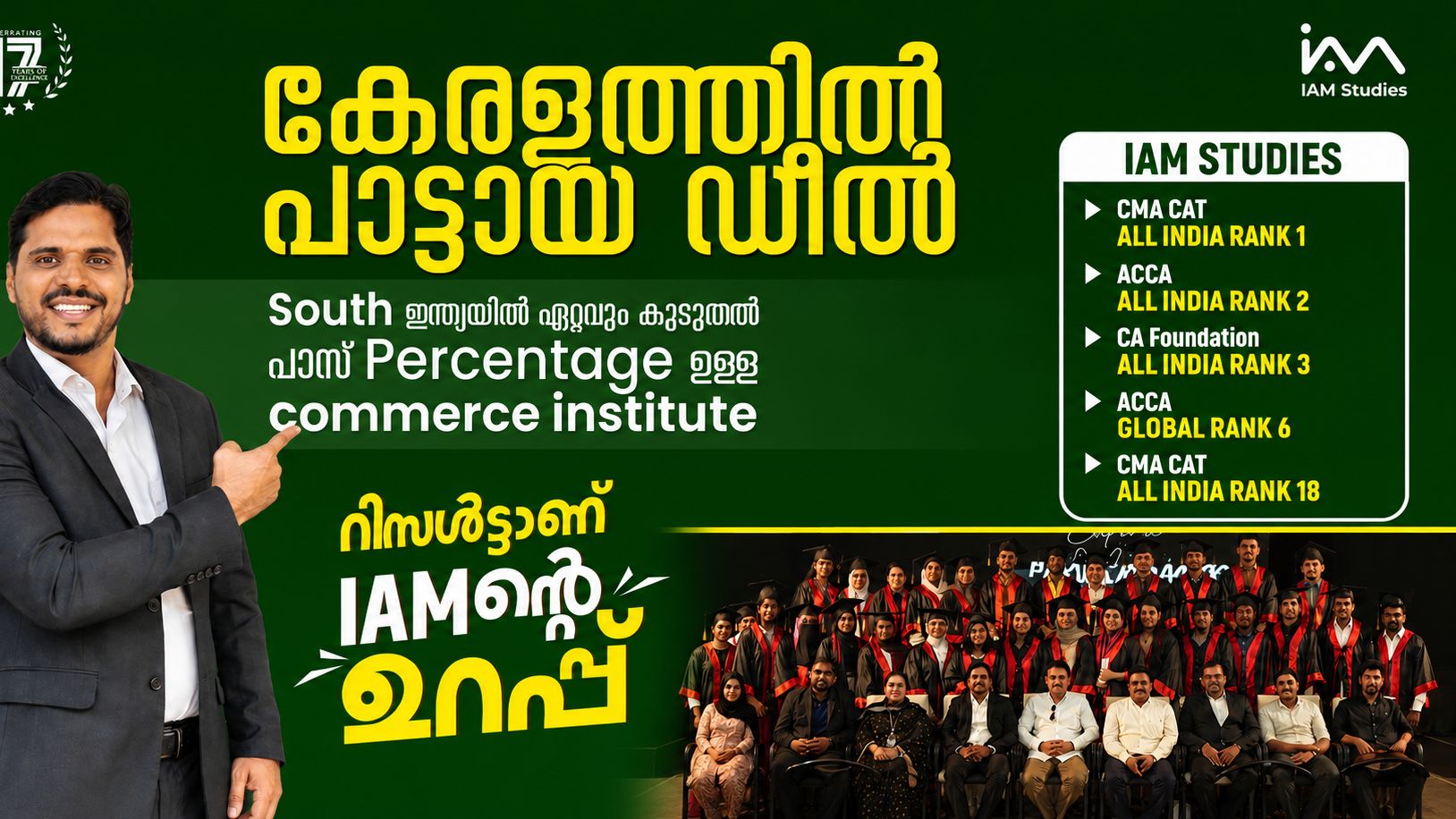
At IAM Studies, we have guided students toward careers like these for 17+ years. We have produced 80+ CA qualifiers in a single year, an ACCA All India Rank 2, a CA Foundation All India Rank 3, a CMA India All India Rank 1, and the youngest CMA India qualifier in the history of India. We are recognised as the highest result-producing commerce institute in South India.
This is not motivation. This is what is possible when preparation meets the right environment.
3. Key Finance Roles in a World Cup Football Club
Here are the specific finance roles that exist inside a top football club or national football association competing at World Cup level.
Finance Manager / Head of Finance
Oversees the entire financial operation of the club. Manages budgets of hundreds of crores, prepares board-level financial reports, controls cash flow, and sets the annual financial strategy. This is the CFO equivalent of the football world.
Transfer Budget Analyst
Every transfer window, clubs spend hundreds of millions buying and selling players. The Transfer Budget Analyst values players using financial modelling, structures fee payment schedules, and ensures the club stays within Financial Fair Play limits.
Revenue and Sponsorship Finance Controller
Manages broadcast deal structures, kit sponsorship contracts, stadium naming rights, and commercial partnerships. Must understand IFRS accounting treatment for deferred revenue and multi-year contracts.
Cost Controller / Management Accountant
Tracks the cost of stadium operations, matchday logistics, travel, and training infrastructure. Produces variance analyses and recommends cost optimisation strategies for every match and every season.
Compliance and Audit Head
FIFA's Financial Fair Play regulations require clubs to certify that their spending does not exceed their revenue beyond set thresholds. Non-compliance means point deductions, transfer bans, or disqualification from competition entirely.
Tax and Legal Finance Advisor
International players earn across multiple countries, triggering complex multi-jurisdictional tax obligations. This role handles player contract taxation, international transfer pricing, and compliance with local tax authorities in every country the club operates in.
Investment and Valuation Analyst
Advises club ownership on acquisitions, stadium development financing, private equity investment structures, and long-term financial sustainability planning.
4. How Your Course Maps to These Roles
| Course | Primary Finance Roles in Football and Sports |
| CA (ICAI) | Finance Manager, CFO, Audit Head, Tax Advisor, Transfer Budget Analyst |
| ACCA | International Finance Controller, IFRS Reporting Specialist, Sponsorship Finance, Gulf Roles |
| CMA India | Cost Controller, Management Accountant, Budget Analyst, Matchday Finance |
| CMA USA | Strategic Finance Manager, Investment Analyst, Global Corporate Finance |
| CS (ICSI) | Compliance Head, Corporate Secretary, Regulatory Affairs, FFP Audit |
Each qualification prepares you for a different dimension of the same financial machine. None is superior to the other — they are built for different functions, exactly like positions on a football pitch.
5. Salary Scope After Qualifying
You do not need to work directly in football to earn at this level. These are the salaries that await you across industries — including sports, entertainment, banking, and corporate finance — after completing your professional course.
| Qualification | Starting CTC (India) | Senior Level CTC (India) | Global / Sports Finance |
| CA (ICAI) | ₹7 – 12 LPA | ₹25 – 60 LPA | ₹80 LPA – ₹2 Crore+ |
| ACCA | ₹6 – 10 LPA | ₹20 – 50 LPA | ₹60 LPA – ₹1.5 Crore (Gulf / UK) |
| CMA USA | $55,000 – $75,000 | $110,000 – $150,000 | $180,000+ |
| CMA India | ₹5 – 9 LPA | ₹18 – 40 LPA | ₹40 – 80 LPA |
| CS (ICSI) | ₹5 – 8 LPA | ₹15 – 35 LPA | ₹35 – 60 LPA |
In the Gulf — where the largest football investments are currently flowing, including clubs owned by Saudi, UAE, and Qatari interests — ACCA and CA professionals are commanding salaries equivalent to ₹18 – 45 LPA at mid-level. With experience, Finance Managers at Gulf football clubs earn equivalent to ₹80 LPA and above.
6. Five Finance Skills the World Cup Demands
1. Budget Management at Scale
The FIFA World Cup requires managing billions of dollars across infrastructure, security, hospitality, media, and operations — simultaneously, across three host nations. CA and ACCA professionals trained in large-scale financial management are the backbone of these operations.
2. International Taxation and Transfer Pricing
When a Brazilian player earns in euros at a Spanish club and trains in the UK, his income touches four tax jurisdictions. CA and ACCA professionals with international taxation knowledge manage these structures to ensure compliance and minimise legitimate tax exposure.
3. Cost Accounting for Event Operations
CMA India and CMA USA professionals track cost per matchday, cost per fan, and cost per broadcast slot across the tournament calendar. Without this, FIFA and host associations cannot know whether they are making or losing money until it is too late.
4. Financial Fair Play Compliance
FIFA's FFP rules exist to prevent clubs from spending beyond their means. CS and CA audit professionals certify that club accounts meet these requirements. Failure to comply results in disqualification — making this one of the highest-stakes compliance roles in sport.
5. Risk Management and Financial Forecasting
Currency fluctuations across three host nations, player injury insurance, ticket revenue forecasting, and broadcast rights risk — all of these require the structured financial thinking taught across CA, CMA USA, and ACCA programmes.
7. The Finance Manager's Weekly Playbook
A Finance Manager at a top football club does not spend their day watching matches. Here is what a typical working week looks like:
| Day | Activity |
| Monday | Board-level financial reporting — P&L, cash flow, balance sheet review |
| Tuesday | Transfer committee meeting — player valuation and contract financial modelling |
| Wednesday | External auditor coordination — Financial Fair Play compliance documentation |
| Thursday | Sponsor finance call — revenue recognition for multi-year deal |
| Friday | Budget variance analysis — stadium operations versus forecast |
| Weekend | Matchday cost monitoring — real-time financial oversight |
Every skill required for that weekly schedule is developed directly through CA, ACCA, CMA USA, CMA India, or CS training. The classroom and the boardroom are closer than most students realise.
8. Why IAM Studies Prepares You for Roles Like These
IAM Studies is not just another coaching centre. We are the highest result-producing commerce institute in South India — a distinction earned over 17 years, not claimed overnight.
Our National-Level Achievements
| Qualification | Achievement |
| CA | 80+ qualifiers in a single year — highest by any Kerala institute |
| CA Foundation | All India Rank 3 |
| ACCA | All India Rank 2 — national level |
| CMA India | All India Rank 1 |
| CMA India | Youngest qualifier in the history of India |
These are published, verifiable results from ICAI, ACCA, and ICMAI — not marketing claims.
What We Offer
| Feature | Details |
| Established | 2009 — 17+ years of results |
| Active Students | 6,000+ currently enrolled |
| Branches | Calicut, Kochi, Kannur, Manjeri, Mangalore, Perinthalmanna |
| Courses | CA, ACCA, CMA India, CMA USA, CS |
| Faculty | Practising CAs, ACCA-qualified coaches, CMA professionals |
| Batch Options | Online and offline; weekday and weekend |
| Mock Tests | Regular internal exams mirroring ICAI / ACCA patterns |
| Articleship Support | Placement network across Kerala and Karnataka |
| Counselling | Free career guidance at all branches |
Most institutes teach the syllabus. IAM Studies teaches students how to think in exams. Our mock test culture, individual performance tracking, and faculty mentoring are what turn enrolled students into national rank holders — not just passers.
When a student from Calicut or Kannur competes against students from Mumbai, Delhi, and Chennai — and wins — it reflects a coaching standard that goes beyond geography.
9. Which Course Should You Choose?
The football analogy is straightforward: a striker and a goalkeeper are both essential to winning a match. Neither role is better. They serve different functions.
The same applies to your professional qualification.
| Question | Choose CA if… | Choose ACCA if… | Choose CMA if… | Choose CS
| Where do you want to work? | India — audit, tax, Indian corporates | Gulf, UK, MNCs, global firms | Manufacturing, operations, cost-heavy industries | Corporate compliance, governance, legal |
| What is your primary interest? | Taxation, audit, financial reporting | International IFRS reporting, global finance | Cost management, operational finance | Governance, regulatory, secretarial |
| Time available? | 4–5 years of intensive study | 2–3 years, more flexible | 2–3 years | 3–4 years |
| Want your own practice? | Yes — CA is required for statutory audit in India | No — corporate employment focus | No — corporate employment focus | Possible in governance consulting |
There is no universally better qualification — only the one that aligns with your career vision.
If you are still unsure: Come in for a free counselling session at any IAM Studies branch. Our faculty — practising CAs, ACCA members, and CMA professionals — will help you choose the right path based on your goals, your timeline, and your strengths.
Your Turn
The Finance Managers who manage billion-dollar football tournaments did not wake up one day with those skills. They studied. They qualified. They put in the work.
The World Cup runs every four years. Your career runs for forty.
Seventeen years of results. South India's highest pass percentage. All India and global rankers. 80+ CA qualifiers in a single year.
IAM Studies is not just a coaching institute. It is proof that when the right preparation meets the right environment, results like these do not just happen once — they keep happening.
Join us. Your finance career starts here.